The 7 Things a Commercial Camera Quote Should Include — Before You Sign It
Share this article:
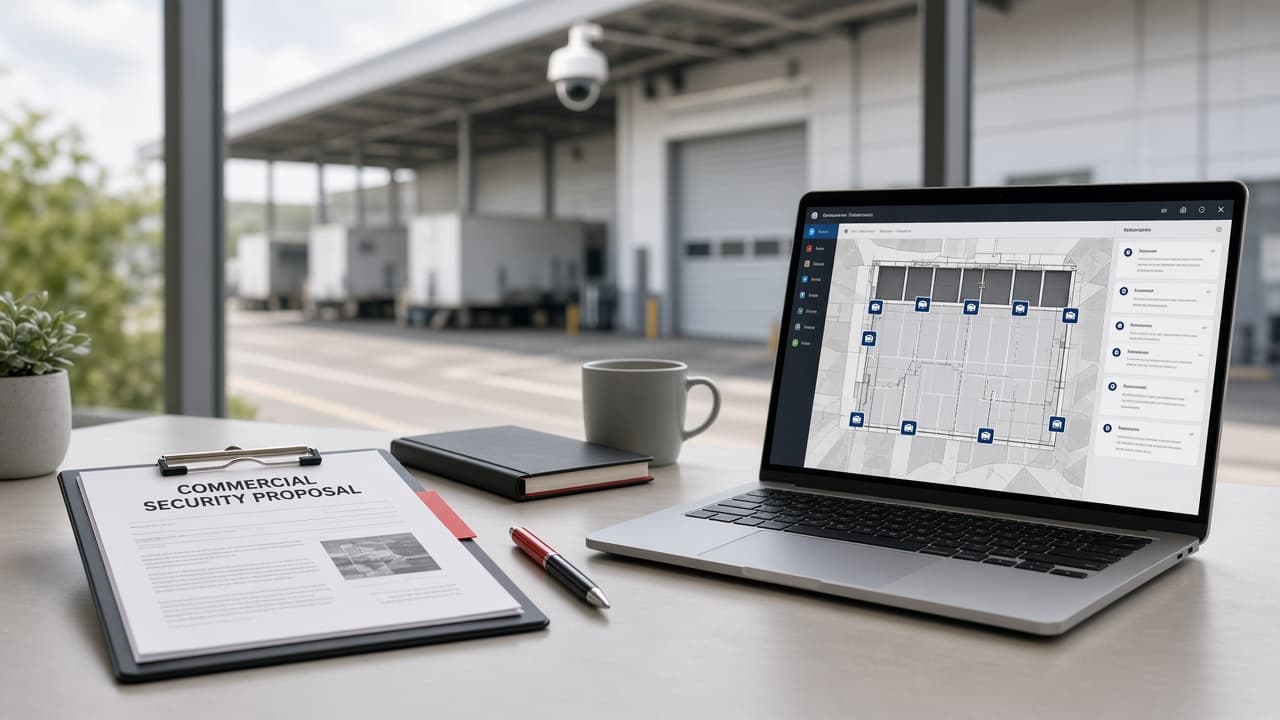
30 sec. overview
The lowest commercial security camera quote is rarely the full story. Before you sign, insist on seven items in writing: a purpose-based camera schedule, coverage map, cabling/PoE plan, recording and retention targets, separated license lines, labor/lifts/exclusions, and handoff/training/warranty. Compare scope first—price second.
If you are comparing bids for commercial security camera installation, the lowest number on the page is rarely the full story. A thin quote can leave out cabling, licensing, retention, or labor—and those gaps show up as change orders after the install crew is already on site.
Before you sign, make sure the proposal answers what you are buying, where it covers, how it connects, and who owns the handoff. The seven items below are the difference between a clean project and an open-ended invoice. For realistic California pricing context while you compare bids, see our commercial security camera system cost guide.
Looking for a second set of eyes on a bid? Ask about a Facility Security Modernization Review, or contact Endpoint Wireless at 1-800-276-0415.
Why the Lowest Quote Often Costs More
Commercial sites across LA, Orange County, the Inland Empire, and San Diego share a pattern: the cheap bid skips scope, then "discovers" work mid-install. That is especially common on logistics and manufacturing campuses where pathway, lift, and after-hours assumptions vary widely between vendors.
Common gaps include:
- No camera schedule — you get "16 cameras" with no model, lens, or purpose.
- Assumed existing cable — until someone finds dead drops or missing PoE budget.
- Recording left vague — retention days and storage sizing show up later as upgrades.
- Licenses buried or omitted — annual software seats become a year-two surprise.
- Labor and lifts excluded — warehouse heights and after-hours work are billed separately.
- No training or warranty language — your team is left guessing after cutover.
A complete quote for commercial security camera installation prices the system you will actually live with—not a starter kit that forces another round of procurement.
The 7 Must-Haves on Every Commercial Camera Quote
1. Camera Schedule Tied to Purpose (Not Just a Headcount)
"24 cameras" is not a design. You need a line-item schedule that maps each camera to a job. Purpose drives lens choice, mounting, and storage—so it belongs in the quote, not in a verbal aside. For placement strategy that pairs with a schedule, see our security camera placement guide.
A solid schedule includes:
- Camera ID / location name (e.g., Dock Door 3, Front Lobby, Yard Gate)
- Purpose (identification, overview, license plate, cash-wrap, perimeter)
- Form factor (dome, bullet, multi-sensor, fisheye) and approximate field-of-view needs
- Indoor vs. outdoor / environmental notes
- Day/night and lighting assumptions when they affect image quality
For logistics yards, that might mean identification-level coverage at doors and overview coverage across trailer lanes. For a retail back office, it might mean tighter views at cash handling and wider views in stock rooms.
If the vendor also proposes cloud-managed platforms, ask them to align models with your use case rather than pushing a catalog. Options such as Verkada, Rhombus, and Avigilon each fit different site preferences—but your schedule should still list what each camera is for, regardless of brand.
2. Coverage Map (Where Blind Spots Are Accepted—or Not)
A camera list without a coverage map is a shopping list. You want a plan that shows approximate camera positions and orientation, areas of primary vs. secondary coverage, known constraints (trees, racking, mezzanines, glare sources), and explicit callouts for areas not covered so expectations match reality.
For warehouses and distribution sites, map dock aprons, fence lines, and high-value cages. For office campuses, map lobby, elevators, stairwells, and parking approaches. The map does not need to be CAD art—it needs to be clear enough that two people reading it reach the same conclusion about what is protected.
Pair the map with a clear security system installation scope so design and install stay aligned from day one. Yard and lot views often also need parking lot camera and LPR callouts when vehicle identification is part of the job.
3. Cabling, Pathways, and PoE Budget
Video systems fail more often on power and path than on the camera body. Your quote should state new vs. reuse of existing cable runs, cable type expectations (typically Cat6 for new commercial drops), pathway method, PoE class / switch port budget and whether switches are included, patch panels and labeling standards, and who owns penetrations, firestopping, and above-ceiling work.
If structured cabling is part of the project—or a prerequisite—get it written as its own clear scope. Many Southern California facilities still have mixed-vintage drops; assuming "there's already cable" is how projects stall. When pathway work is significant, price structured cabling as a defined line, not a vague allowance. Related network readiness often includes network setup and MDF/IDF buildout.
Also clarify:
- Network VLAN / segment assumptions (who provides switch config)
- UPS expectations for NVRs or critical switches
- Outdoor cable and weatherproofing notes
4. Recording Architecture and Retention Targets
Ask: where do recordings live, and for how many days? The quote should specify on-prem NVR, hybrid, or cloud recording model; retention target in days (and at what quality/bitrate assumptions); storage sizing method; motion vs. continuous recording assumptions; export / evidence workflow basics; and bandwidth impact if cloud or hybrid is proposed.
Retention is a business decision (policy, insurance, investigation needs)—not a vendor afterthought. A logistics operator may need longer dock coverage; a small office may accept shorter lobby retention. Put the number in writing so "we thought we had 30 days" does not become a dispute after an incident.
If you are still deciding between cloud and traditional recording, compare architecture tradeoffs in cloud cameras vs traditional DVR/NVR and our cloud security camera guide. For software/platform expectations, also review video management software scope.
5. License Lines Separated From Hardware
Software seats, cloud subscriptions, and analytics packs are often where quotes look cheap—and invoices grow. Require a license section that lists per-camera or per-site licenses (what is included year one), renewal terms and approximate renewal timing, features gated behind licenses (search, analytics, mobile apps, SSO), whether licenses are transferable if cameras are moved, and any "free trial" periods that expire into paid seats.
Do not let "cameras included" hide annual software. If access control is part of the same modernization wave, keep those license lines separate too—door controllers and video often share pathway work but rarely share the same subscription math. Review access control installation alongside your camera bid when both are on the roadmap, and avoid the pitfalls covered in common access control mistakes.
6. Labor, Lifts, After-Hours, and Exclusions
Labor is where commercial installs diverge from residential. Your quote should show installation labor assumptions (crew size / estimated hours or fixed price basis), lift / boom / scissor needs for high mounts (and who provides them), after-hours or weekend premiums if your site requires them, patching/painting/ceiling-tile work, permits and inspections, and customer-provided items (network, power at IDF, escorts, badges).
Exclusions matter as much as inclusions. A clean exclusions list protects both sides. Typical commercial exclusions to watch for: core drilling, trenching, drywall repair, electrical panel upgrades, and IT configuration beyond camera VLANs.
For industrial and logistics environments—common across Inland Empire corridors and similar SoCal hubs—lift time and after-hours work are not edge cases. Price them up front so the install does not pause while someone finds a boom lift. Warehouse-specific camera planning is covered in best security cameras for warehouses in the Inland Empire.
7. Handoff, Training, Documentation, and Warranty
Cutover is not complete when the last camera comes online. The quote should define as-built documentation (camera map, IP/MAC list, login handoff process), admin and end-user training (who, how long, remote vs. on-site), warranty length on labor and hardware plus RMA process basics, support hours and escalation path after go-live, and acceptance criteria (what "done" means before final payment).
Without this section, you own a system your staff cannot operate. Ask for a short admin session plus a one-page "how to export video" guide—simple items that save hours during the first incident review. Ongoing reliability also depends on preventative maintenance after go-live.
How to Compare Two Quotes Side by Side
When you have two or three proposals, score them on completeness—not just total price.
Use this checklist:
- Same camera count and purposes? Or is one quote under-covering doors and yards?
- Same cabling assumptions? New drops vs. reuse changes cost dramatically.
- Same retention days and recording model? Apples-to-apples storage.
- Licenses shown for year one and renewals? Hidden SaaS is not a discount.
- Labor and lifts included? Or "TBD" that will become a change order?
- Training and warranty written? Or assumed.
A higher bid that includes PoE switches, 30-day retention, lift rental, and training can still be the lower total cost of ownership. A lower bid that excludes pathway work is a partial project.
If you are refreshing older analog or mixed systems, treat the project as modernization—not a camera swap. Cabling, switching, and retention policy usually need a refresh together. That is exactly when a Facility Security Modernization Review helps you sequence work without buying hardware your network cannot support.
Practical Examples (Without Invented Proof Claims)
These are typical scope patterns—not guaranteed outcomes or ROI figures:
- Distribution warehouse: identification cameras at dock doors, overview coverage on yard lanes, longer retention on docks than on office hallways, lift-dependent mounting at rack height.
- Multi-tenant office: lobby and elevator lobby coverage, parking approach views, shared IDF coordination, clear after-hours install windows.
- Light manufacturing: machine-area overview (policy-compliant placement), shipping desk identification views, cable pathways that avoid production interference.
In each case, the quote should spell out purpose, pathway, retention, and handoff—not just a camera SKU list. Brand choice matters for management style, but purpose and infrastructure decide whether the system works on day 30. For a deeper warehouse modernization walkthrough, see how to secure a 50,000 sq ft warehouse.
FAQs
What should a commercial security camera installation quote include at minimum?
At minimum: a purpose-based camera schedule, coverage map, cabling/PoE plan, recording and retention targets, license line items, labor/lifts/exclusions, and handoff/training/warranty terms.
Why do camera quotes vary so widely between vendors?
Vendors price different assumptions—reuse vs. new cable, retention days, cloud licenses, lift rental, and after-hours labor. Ask each bidder to state those assumptions in writing so you can compare scope, not just totals.
Should cloud camera licenses be on a separate line?
Yes. Separate hardware, install labor, and recurring licenses. That keeps renewals visible and prevents "cheap cameras" from becoming expensive subscriptions without warning.
How many days of retention do most commercial sites need?
It depends on policy, insurance, and investigation needs. Many sites start with a stated target (for example, two to four weeks) and adjust by camera group—longer on docks and cash areas, shorter on low-risk corridors. Put the target in the quote.
Do I need new cabling for every camera upgrade?
Not always—but do not assume existing drops are healthy or PoE-ready. A good quote tests or documents reuse assumptions and prices new runs where needed through a defined cabling scope.
Can access control and cameras be quoted together?
Yes, and it often reduces duplicate pathway work. Keep camera and access scopes and licenses clearly separated so each system stays maintainable. Review access control installation alongside your camera bid when both are on the roadmap.
What is a Facility Security Modernization Review?
It is a structured look at cameras, cabling, and related controls before you commit to a partial upgrade—so you avoid buying cameras that your network, power, or retention plan cannot support. Contact our team to ask about scheduling one for your facility.
Next Step: Get Scope Clarity Before You Sign
Do not sign a camera quote that only lists headcount and a lump sum. Insist on the seven must-haves above. If a vendor cannot explain coverage, cabling, retention, licenses, and handoff in writing, they are asking you to fund discovery during installation.
Ready to pressure-test a bid or plan a clean install?
- Call 1-800-276-0415
- Ask about a Facility Security Modernization Review via our contact page
- Browse more guidance on the Endpoint Wireless blog
Whether you operate in Los Angeles County, Orange County, the Inland Empire, or San Diego County, clear scope protects your budget—and your ability to actually use the system after go-live. Explore our Southern California service locations to see coverage in your area.
Need a second set of eyes on a camera bid?
Ask about a Facility Security Modernization Review, or get a transparent quote for commercial camera installation across Southern California