Camera Quote Red Flags That Turn Into Change Orders
Share this article:
30 sec. overview
The lowest commercial camera quote often wins on paper and loses on the job site. Watch for eight red flags—lump-sum labor, TBDs, missing outdoor/lift scope, free PoE assumptions, vague retention, license mismatches, access-control phase-2 traps, and unpriced after-hours work—before exclusions turn into change orders.
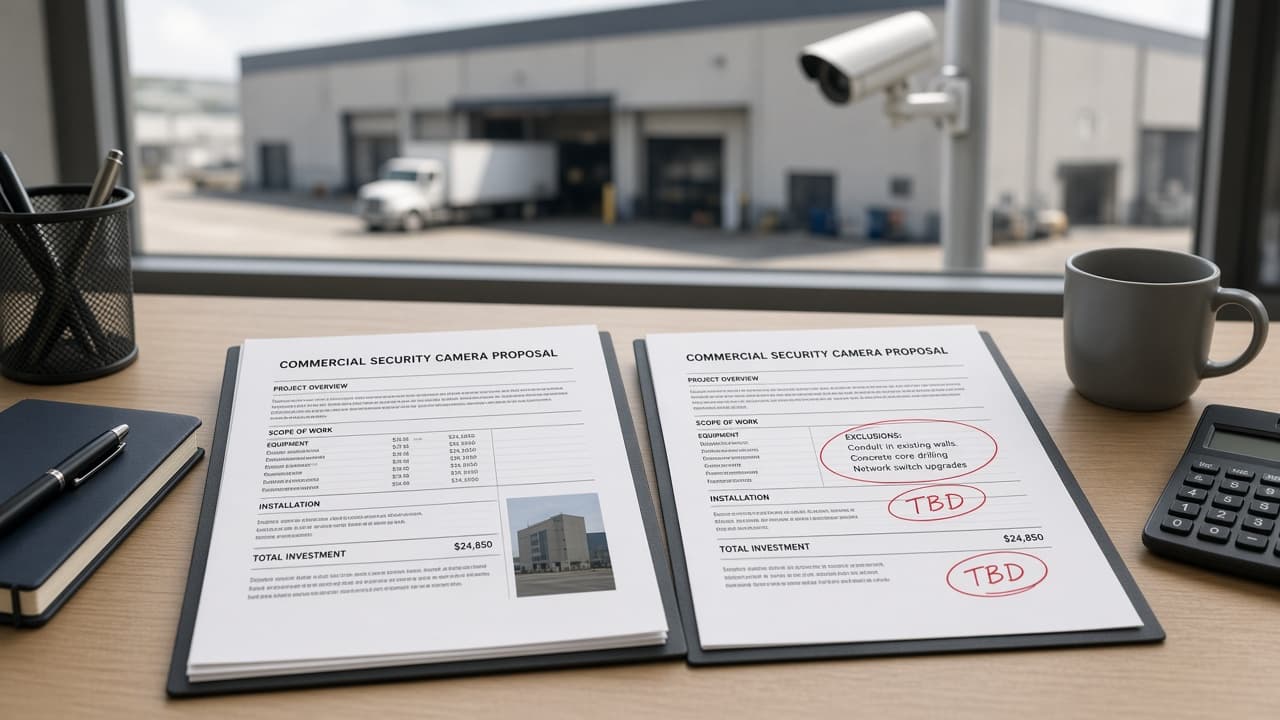
The lowest commercial camera quote often wins on paper and loses on the job site. The gap is rarely "the cameras were wrong." It is exclusions, assumptions, and soft language that look harmless until Facilities, IT, and Finance are staring at a change order for lifts, outdoor pathways, PoE switches, after-hours labor, or another year of licenses.
If you are comparing bids for a warehouse, plant, office, or retail site in Southern California, treat this as a red-flag literacy pass—not a brand bake-off. End-Point Wireless (Ontario, CA) regularly reviews competitor proposals with Facilities and IT so the number you sign matches the system you need. Call 1-800-276-0415 if you want a quote walkthrough before you PO.
Pair this checklist with the seven must-haves every commercial camera quote should include and our California commercial camera cost guide when you are comparing bids on scope and price together.
Why Commercial Camera Quote Exclusions Turn Into Dollars
A complete proposal for security system installation should make coverage, pathways, power, recording, licenses, labor windows, and handoff explicit. When those items are missing, vendors do not invent free work later—they issue change orders.
Red flags share a pattern: the line item looks finished, but the risk was shifted to you. Your job before signature is to force every assumption into a price, an allowance with a real number, or a clear "owner-furnished" note IT and Facilities both accept.
Red Flag 1: Cameras + Labor as a Lump Sum
"32 cameras + install labor — $XX,XXX" is the classic under-scope package. It hides whether labor includes pathway pulls, termination, switch configuration, lift time, outdoor weatherproofing, labeling, training, and as-builts—or only hang-and-power on existing drops.
What Usually Gets Buried Inside the Lump
- Camera schedule without purpose (dock vs lobby vs aisle)
- No coverage map or FOV notes
- Cabling treated as "included" without pathway reality
- Closet termination and patching left vague
- Commissioning and user training as goodwill, not scope
Ask for a camera schedule, a labor breakdown by task, and a written exclusions list. If the vendor will not unbundle, assume the lump is priced for best-case indoor office ceilings—not a live Inland Empire dock or a multi-IDF manufacturing floor. Purpose-based placement guidance is covered in our security camera placement guide.
Red Flag 2: TBD, Allowance, and "To Be Determined" Language
TBDs feel flexible. On commercial camera jobs they usually mean you accepted an incomplete design. Common soft spots:
- "Outdoor cameras — TBD pending survey"
- "Pathway / conduit allowance — as needed"
- "Network upgrades — owner responsibility"
- "Additional cameras at unit price"
Allowances are fine when they are named, numbered, and tied to a decision date. A $2,500 pathway allowance on a high-bay warehouse with no tray and long outdoor runs is not an allowance—it is a future change order wearing a polite label.
How to Neutralize TBD Risk
- Convert every TBD into include / exclude / owner-furnish with a dollar or unit rate
- Cap allowances and define what burns them (lift days, conduit LF, switch ports)
- Require a post-survey true-up before final PO if the first bid was desk-based
If the first proposal was built from photos or a floor plan alone, treat large TBDs as proof the survey still owns the real price.
Red Flag 3: Missing Outdoor, Yard, and Lift Scope
Indoor camera counts look cheap. Yard poles, parking canopies, gate approaches, and high-bay mounts do not. Quotes that list outdoor cameras but omit lifts, bucket time, weather-rated enclosures, grounding, and conduit are change-order machines—especially across SoCal logistics corridors where docks and lots are the real investigation surface.
Questions That Expose Outdoor Gaps
- Is a scissor or boom lift included, and for how many days?
- Who owns pole bases, junction boxes, and UV-rated pathways?
- Are night/IR or low-light performance assumptions written down?
- Does "outdoor included" mean cameras only, or cameras + pathway + mount + lift?
For distribution and DC sites, compare outdoor honesty against EPW's logistics context: dock disputes and yard movement fail when the quote only priced warehouse aisle domes. Manufacturing floors have the same lift economics when high-bay and production pathways drive cost more than camera SKUs. Also weigh parking lot cameras and LPR when vehicle approaches are in scope.
A Fontana or Ontario yard camera that needs a boom over live truck lanes is not the same labor line as a hallway dome. If lift language is absent, price it yourself before you celebrate the low bid. Warehouse-specific planning is covered in best security cameras for warehouses in the Inland Empire.
Red Flag 4: PoE and Network Treated as Free
"Cameras are PoE—just plug into your switch" is the fastest way to discover mid-install that closets are out of budget, uplinks are saturated, or IT never agreed to VLAN changes. Commercial IP cameras are a network load. Assuming spare PoE, spare ports, and clean pathways is an exclusion even when the word "exclusion" never appears.
What an Honest Quote Says About the Network
- PoE budget check by closet (MDF/IDF)
- Switch adds or PoE injectors if capacity is short
- Who configures VLANs, DHCP reservations, and firewall rules
- Pathway ownership: new Cat6 pulls vs existing drops
- Termination, labeling, and patch documentation
When pathways and closets need work, fold in structured cabling as scoped reality—not a surprise day-of discovery. Related closet work often includes MDF/IDF buildout and network setup. Cloud-managed options such as Verkada or Rhombus still need clean power and network; platform choice does not erase closet math.
If IT is "owner-furnished," put that in writing with names and deadlines. Unsigned network assumptions become your change order when the crew is already on site.
Red Flag 5: Retention Unspecified
A quote that never states how many days of video you keep—or what storage assumption supports that number—is incomplete. Retention drives cloud subscription tiers, NVR size, uplink planning, and whether LP can actually pull a claim clip two weeks later.
Force Retention Onto the Page
- Days of continuous recording per camera or per site policy
- Event-only vs continuous assumptions (and who decides)
- What happens when retention is raised after go-live (true-up)
- Export rights and who can search without vendor tickets
"Industry standard retention" is not a specification. Your insurance, counsel, and LP workflow are. Put the number in the SOW so a later "we need 60 days, not 14" is a deliberate upgrade—not an argument about what was implied. Architecture tradeoffs are covered in cloud cameras vs traditional DVR/NVR and video management software scope.
Red Flag 6: License Term Mismatch
Hardware CapEx and license OpEx get mixed on purpose or by accident. Red flags include:
- Cameras priced with 1-year licenses while your finance plan assumes three or five
- "License included" without saying per camera, per site, or per user seat
- Renewal pricing absent or "quoted at renewal"
- Multi-site admin seats assumed free
- Hybrid/NVR lines next to cloud lines with no ownership of who renews what
Ask for a license matrix: product, term, quantity, renewal owner, and what stops recording if a renewal lapses. Align the term with your budget cycle before signature. A cheaper year-one number with a painful year-two true-up is still a change order—just delayed. For platform pricing context, see our Verkada cameras price guide.
Red Flag 7: Access-Control "Phase 2" Traps
Many camera quotes whisper that doors, badges, and gates are "phase 2." That can be smart sequencing—or a way to win video now and reopen pathways, closets, and door hardware later at premium disruption cost.
Phase-2 Language That Should Worry You
- "Access control available later" with no pathway stubs or door schedule
- Camera drops at doors without power or backbox notes for readers/locks
- No integration intent (video + forced door / after-hours entry review)
- Separate vendors for cameras and access with no shared network plan
If doors matter in year one, design cameras and access control installation as one system—even if purchase is phased. Stub pathways, share closet plans, and align door cameras with the doors you will badge. Otherwise phase 2 pays twice for lifts, ceiling opens, and after-hours windows you already burned in phase 1. Avoid the traps covered in common access control mistakes.
Red Flag 8: After-Hours Labor Not Priced
Daytime-only labor assumptions fail on live docks, retail floors, and office lobbies. If the quote assumes 7 a.m.–3 p.m. access and your site cannot give it, nights and weekends show up as change orders—often with lift premiums stacked on top.
Lock the Install Window in Writing
- Which zones are daytime-safe vs after-hours only
- Overtime / weekend rates and estimated hours
- Carrier or production blackout windows (especially warehouse docks)
- Who escorts the crew and who accepts nightly partial go-lives
SoCal commercial sites—from LA County offices to IE warehouses to OC retail—rarely get full shutdowns. Price disruption honestly or the "cheap" bid is fiction.
How to Rewrite the RFP Ask (So Red Flags Cannot Hide)
You do not need a 40-page RFP. You need a scope skeleton that forces exclusions into the open. Paste a version of this into your bid package:
- Camera schedule with zone purpose (door, dock, yard, lobby, high-value, production)
- Coverage map attachment (markups acceptable)
- Pathway and PoE responsibility matrix (contractor vs owner IT)
- Outdoor / lift / conduit include-or-exclude table
- Retention days and recording architecture (cloud, NVR, hybrid)
- License term, quantity, and renewal owner
- Labor window assumptions and after-hours rates
- Access-control phase plan (in scope now, stubbed, or explicitly out)
- Handoff package (as-builts, credentials model, training audience)
- Exclusions list in the vendor's own words—no silent assumptions
Score bids on completeness and risk, not camera count alone. A higher transparent number often beats a low lump sum with TBDs. For commercial camera installation, completeness protects budget more than a thin headcount win.
How End-Point Wireless Reviews a Quote You Already Have
Bring the competitor PDF (and your site constraints). A practical review covers exclusions, outdoor/lift honesty, closet reality, retention and license math, and whether access should be designed now even if purchased later. EPW installs commercial camera and low-voltage systems from the Fontana / Ontario corridor across Los Angeles County, Orange County, the Inland Empire, and San Diego County—so the review is grounded in live SoCal site conditions, not a national template.
Ask for a Facility Security Modernization Review when cameras, doors, and network need one phased map—not three disconnected projects. Start through our contact page or browse service locations near your site.
FAQs
What is the most expensive commercial camera quote exclusion?
It depends on the site, but outdoor pathway + lift gaps and PoE/switch shortfalls are frequent big hits. After-hours labor stacked on lifts can rival hardware deltas on live warehouses and retail floors.
Is a unit-price "additional camera" line enough protection?
Only if pathway, mount, lift, license, and commissioning are defined for that unit. A camera-only add rate still leaves you open on everything around the camera.
Can we accept a TBD if we will survey next week?
Yes—if the contract says final price is survey-based and you do not issue a full PO on the incomplete number. Desk bids with large TBDs should not be treated as firm.
Should retention be the same for every camera?
Not always. Door and dock cameras often need longer searchable history than a low-risk overview. Specify by class of camera so you are not paying peak retention everywhere by accident—or discovering gaps when LP needs a clip.
How do license term mismatches show up after install?
As renewal invoices, disabled features, or storage caps you did not budget. Put term length and renewal owner in the SOW before hardware ships.
If access control is truly next year, what should this year's camera quote still include?
Door-adjacent camera intent, pathway stubs where walls will open anyway, closet capacity notes, and a written phase-2 interface plan. Do not pay twice for the same ceiling. Plan that interface with access control installation in mind.
Are cloud camera quotes immune to these red flags?
No. Cloud-managed platforms still need pathways, PoE, mounts, lifts, retention settings, and license clarity. The red flags move; they do not disappear. See what a cloud security camera system includes.
How do we get a red-flag review with End-Point Wireless?
Call 1-800-276-0415 or use the contact page. Say you want a commercial camera quote review or a Facility Security Modernization Review, and whether Facilities and IT can join.
Turn Red Flags Into a Clean Scope Before You Sign
Commercial camera quote exclusions become change orders when lump-sum labor, TBDs, missing outdoor/lift scope, free PoE assumptions, vague retention, license mismatches, access-control phase-2 traps, and unpriced after-hours work stay unchallenged. Rewrite the ask, force assumptions onto the page, and compare risk—not just the bottom line.
End-Point Wireless helps SoCal facilities pressure-test proposals and design cameras, cabling, and access as one system. Call 1-800-276-0415 and ask for a Facility Security Modernization Review—or send your current quote through the contact page and request an exclusions walkthrough before you sign. More guidance lives on the Endpoint Wireless blog.
Want a red-flag review of a camera bid?
Ask about a Facility Security Modernization Review, or get a transparent quote for commercial camera installation across Southern California