What a Site Survey Should Put on Your Commercial Camera Quote
Share this article:
30 sec. overview
A commercial camera site survey only earns its keep when it changes the quote. Demand survey artifacts on the proposal—coverage map, PoE budget by closet, pathway notes, mounts/environment, network ownership matrix, and a phased BOM—not a sales walk and a cameras-plus-labor lump sum.
A commercial camera site survey only earns its keep when it changes the quote. If the walk ends with "we'll send pricing" and the PDF is still cameras-plus-labor with no attachments, you did not get a survey—you got a sales visit. Facilities, IT, and Ops buyers in Southern California should treat survey outputs as quote line-item artifacts: documents and tables that explain why each camera, cable path, switch port, and phase exists.
This article is about that translation. Not "what cameras are cool," and not a generic completeness checklist. It is about the survey deliverables that must appear on—or attached to—your commercial camera quote so change orders do not rewrite the job after you sign. For what those quote lines should include once the survey is done, see the seven must-haves on every commercial camera quote and red flags that turn into change orders.
End-Point Wireless (Ontario, CA) scopes commercial camera work this way across Los Angeles County, Orange County, the Inland Empire, and San Diego County. Call 1-800-276-0415 when you want a survey that produces quote artifacts, not vibes.
A Site Survey Is Not a Sales Walk
A sales walk is short and optimistic: a lobby glance, a door count from memory, "about twenty cameras." A real commercial camera site survey is slower and more useful. It walks investigation goals—dock disputes, after-hours entries, yard movement, lobby incidents—and records the physical and network constraints that price those goals honestly.
What a Real Survey Produces (vs. What a Walk Produces)
- Sales walk: camera count guess → Survey on the quote: named zones + purpose per camera
- Sales walk: "we'll figure cabling" → Survey on the quote: pathway / conduit / tray notes
- Sales walk: assumed spare PoE → Survey on the quote: PoE budget table by closet
- Sales walk: generic mount SKUs → Survey on the quote: mount + environment notes
- Sales walk: "IT will handle network" → Survey on the quote: network ownership matrix
- Sales walk: one lump BOM → Survey on the quote: phased BOM by survey priority
If your vendor cannot show those artifacts, they cannot defend their number. Push for them before you compare bids. For how End-Point Wireless scopes full camera projects after a proper survey, see security system installation.
Ask who attends. Facilities alone miss switch/VLAN reality; IT alone misses dock windows and night lighting; LP alone may skip closet access and lifts. Best surveys put Facilities + IT (and LP when investigations matter) on the same walk.
Coverage Map as a Quote Attachment
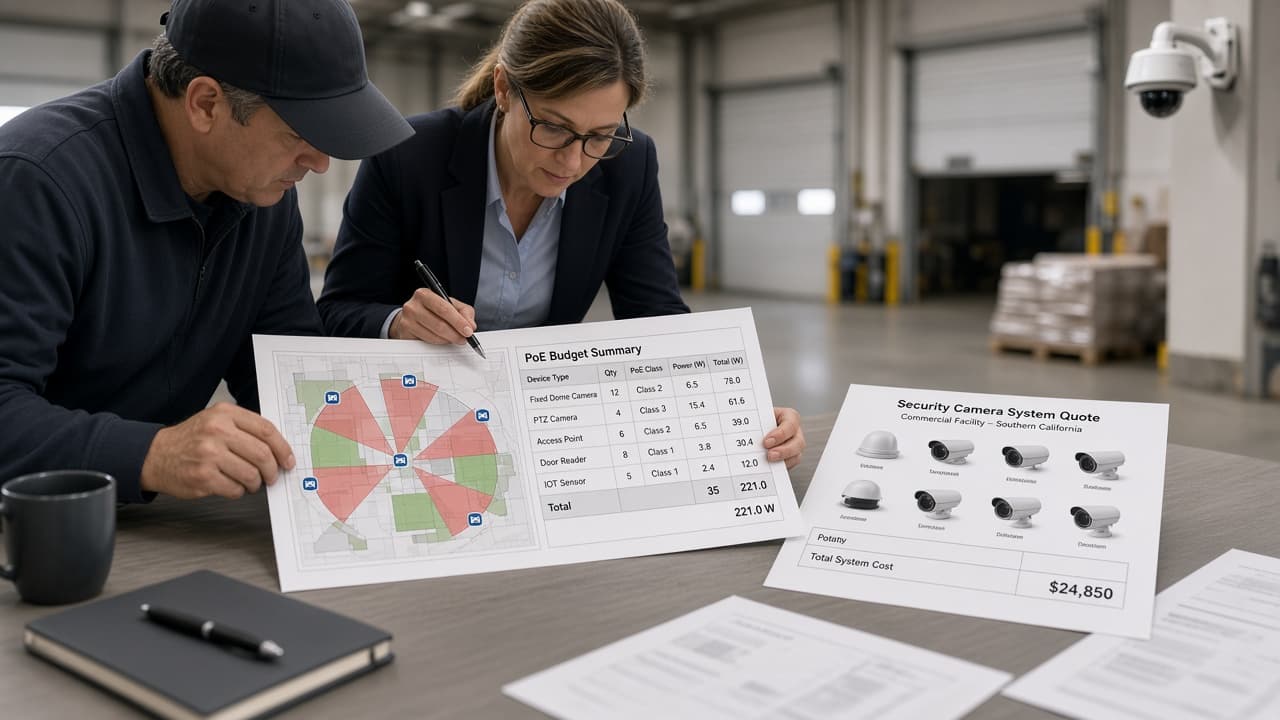
The coverage map is the first survey artifact that should ride with the quote—not as marketing wallpaper, but as the scope of what you are buying.
A useful coverage map is not "dots on a floor plan." It states, zone by zone:
- Investigation purpose — dock seal/trailer presence, employee door identity, yard approach, lobby visitor context, cage/high-value storage
- Priority — must-have vs phase-two vs nice-to-have
- Sightline risks — racking, glare, forklift traffic, canopy shadows, propped doors
- Camera intent — overview vs identity vs bay-level detail (in plain language, not brochure jargon)
- Name that will match the UI — "Dock 3 Seal," not "Cam07"
When the map is an attachment, camera lines can reference it—"Dock 3 Seal — outdoor bullet — phase 1"—so you compare vendors without megapixel theater. Pair the map with placement strategy from our security camera placement guide.
Inland Empire logistics sites feel this first: a Rancho Cucamonga cross-dock and an Ontario DC do not share an Irvine lobby map. Freight-heavy teams should review EPW's logistics context and insist the survey map matches carrier and product flow.
Quote Line Items the Map Should Unlock
- Camera schedule keyed to map zone IDs
- Explicit "not in phase 1" zones (honest exclusions)
- Lift/access notes for high-bay or outdoor poles needed to hit the FOV
- Night verification for docks and lots (day-only coverage is incomplete)
No map attachment usually means the low bid is guessing—and Dock 7 or the yard gate shows up as a change order later. Yard and lot intent often also needs parking lot camera or LPR callouts when vehicle approaches matter.
PoE Budget Table (Closet by Closet)
Commercial IP cameras live on PoE. A survey that never opens a closet is incomplete. The quote artifact is a PoE budget table—simple enough for Facilities to read, specific enough for IT to challenge.
What the Table Should Show
For each MDF/IDF (or outdoor enclosure):
- Closet name / location and which camera zones it feeds
- Available PoE ports and watt budget vs. cameras planned
- Switch adds, injectors, or upsizing required (and who buys them)
- Uplink / bandwidth notes if cloud or high-bitrate streams are proposed
- Phase-1 load vs. reserved headroom for phase 2
SoCal multi-IDF warehouses are the trap: office MDF looks fine; the dock-side IDF is full. "Site PoE OK" is not a survey deliverable—closet-by-closet is. Closet work often pairs with MDF/IDF buildout and network setup.
Pathway, Conduit, and Tray Notes
Cable is where camera quotes quietly lie. The survey should produce pathway notes that become priced lines or explicit exclusions—not "cabling included" with no path.
Pathway Artifacts That Belong on the Quote
- New vs. reuse of existing drops (and which drops were verified)
- Pathway method by zone: conduit, tray, above ceiling, exterior raceway
- Estimated footage or unit rates for outdoor / high-bay exceptions
- Penetration, firestopping, and above-ceiling ownership
- Explicit exclusions (trenching, core drilling, landlord-restricted paths)
When pathway work is significant, price structured cabling as a defined scope—not a vague allowance that becomes a change order mid-install.
Mounting and Environmental Notes
Mounts and environment decide whether the coverage map survives year one. Survey notes should become SKU-level or clear assembly lines—not "mounts as needed."
What to Capture on the Walk (and Print on the Quote)
- Indoor vs outdoor / weather-rated requirements by zone
- Mount type: wall, pendant, pole, parapet, high-bay, corner
- Lift or boom needs and estimated days for high or outdoor mounts
- Lighting assumptions (day/night, IR, glare sources under canopies)
- Vandal or impact risk near docks, gates, and public areas
An outdoor yard pole next to an indoor high-bay dome is not one "mounts included" line. Survey detail keeps those realities priced before signature—especially on manufacturing floors and IE warehouses covered in warehouse camera guidance for the Inland Empire.
Network Ownership Matrix
Unsigned network assumptions are change orders waiting for a crew day. Put ownership in a matrix Facilities and IT both sign off on.
Matrix Rows Worth Putting in Writing
- VLAN creation / segmentation — contractor vs owner IT
- DHCP reservations, DNS, and firewall rules
- Switch configuration and PoE port assignment
- Cloud platform onboarding vs on-prem NVR ownership
- SSO / admin accounts and who holds credentials after handoff
- Deadlines: when IT deliverables must be ready relative to install start
Cloud-managed platforms such as Verkada or Rhombus still need clean power and network; platform choice does not erase closet math. Architecture tradeoffs are covered in cloud vs traditional DVR/NVR.
Phased BOM from Survey Priorities
Budgets rarely fund every nice-to-have on day one. A strong survey turns priorities into a phased BOM that still protects pathways and closets for later work.
How a Phased BOM Should Read
Phase 1 — investigation-critical
- Doors, docks, high-dispute/high-value zones from the map
- PoE/closet work for phase 1 (stub phase-2 capacity when cheap now)
- Mounts, lifts, outdoor pathways for those zones only
- Recording/retention sized for phase 1 (true-up note if phase 2 adds cameras)
Phase 2 — expand coverage
- Yard, secondary corridors, aisle fills, overflow lots
- Cameras reusing phase-1 pathways/stubs
- Switch or license true-ups called out as contingent
Phase 3 — integrations / polish (only if surveyed)
- Access-event pairing, gate/LPR readiness, multi-site admin consistency
- Training for swing shift / multi-building users
Phasing is how live SoCal warehouses, retail floors, and offices keep moving while buying a coherent system. If phase 1 is "cheapest cameras first" instead of highest investigation value, you still get blind docks and a pretty lobby. Label hardware and labor by phase—an unsorted BOM invites scope reshuffles after signature. When doors are in a later phase, still design camera pathways with access control installation in mind so you do not pay twice for the same ceiling.
How to Reject a Quote That Ignored the Survey
When two PDFs look similar, ask:
- Coverage map attached and referenced by camera lines?
- PoE budget table by closet—or only "customer-furnished network"?
- Pathway/conduit/tray notes as lines or exclusions?
- Mounts/environment match outdoor vs indoor zones?
- Network ownership written, with IT named where required?
- BOM phased by survey priority—or one opaque list?
Three or more "no" answers means you are comparing a surveyed design to a hopeful estimate. Make the hopeful vendor fill the gaps—or walk. Local IE crews (Ontario, Rancho Cucamonga corridor) know dock windows and multi-IDF plants better than Street View estimates—but geography alone is not a survey. Verify the artifacts. For pricing context while you compare surveyed bids, see our California commercial camera cost guide.
FAQs
What should I receive after a commercial camera site survey?
At minimum: coverage map with priorities, PoE/closet check, pathway and mount notes, network ownership split, and a draft phased BOM as quote attachments. A verbal "about X cameras" is not enough—get artifacts in writing before you accept a proposal.
How is a survey different from a sales walk?
A sales walk estimates. A survey documents constraints and intent that must appear on the quote. Closet access, dock/yard walkthrough, and IT participation are usual signals. Proof is the attachments—not visit length.
Can we get a firm quote without opening network closets?
You can get a preliminary budget—not a firm number. PoE, uplink, and termination closets change materials and labor. Mark pre-closet pricing provisional until the PoE table exists.
Who should attend the site survey?
Facilities/Ops for workflows and disruption, IT for switches/VLANs/identity, and LP when investigations matter. Landlord or GC help on leased or construction sites. Missing IT is the top reason quotes stall after signature.
What if budget only covers phase 1?
Normal. Keep phase 1 on survey priorities (doors/docks/high-dispute zones). Price or explicitly defer phase-2 stubs and closet headroom—do not let phase 1 consume every port.
Do outdoor cameras always need separate pathway lines?
Often yes—yard poles, canopies, and gates rarely share office corridor methods. The survey should say so; the quote should show it. One bundled cabling line hides outdoor risk.
Should the survey pick the camera brand?
Lock coverage intent, environment, network ownership, and retention first. Brand and recording platform follow. Evaluate platforms against the surveyed design—not the other way around. Browse cloud security cameras only after the artifacts exist.
How do we schedule a survey that produces quote artifacts with End-Point Wireless?
Call 1-800-276-0415 and ask for a commercial camera site survey with Facilities and IT on the walk. State facility type and whether you already hold a competitor quote missing attachments—or start from the contact page.
Put the Survey on the Page—Then Sign
A commercial camera quote without survey artifacts is a promise without a drawing. Demand the coverage map, PoE budget table, pathway notes, mounting/environment detail, network ownership matrix, and phased BOM as part of the proposal package. That is how Southern California facilities keep change orders from rewriting the job after the PO.
End-Point Wireless designs and installs commercial camera and low-voltage systems from Ontario, CA for sites across LA County, Orange County, the Inland Empire, and San Diego County. When you want a Facility Security Modernization Review—a structured walk with Facilities, LP/Ops, and IT that leaves a phased map for cameras, access, and network—call 1-800-276-0415 and ask for that review by name. More guidance is on the Endpoint Wireless blog and service locations.
Want a survey that produces quote artifacts?
Ask about a Facility Security Modernization Review, or schedule a commercial camera site survey for camera installation across Southern California