One Low Voltage Contractor vs. Five Vendors: The Hidden Cost of Split Accountability
Share this article:
30 sec. overview
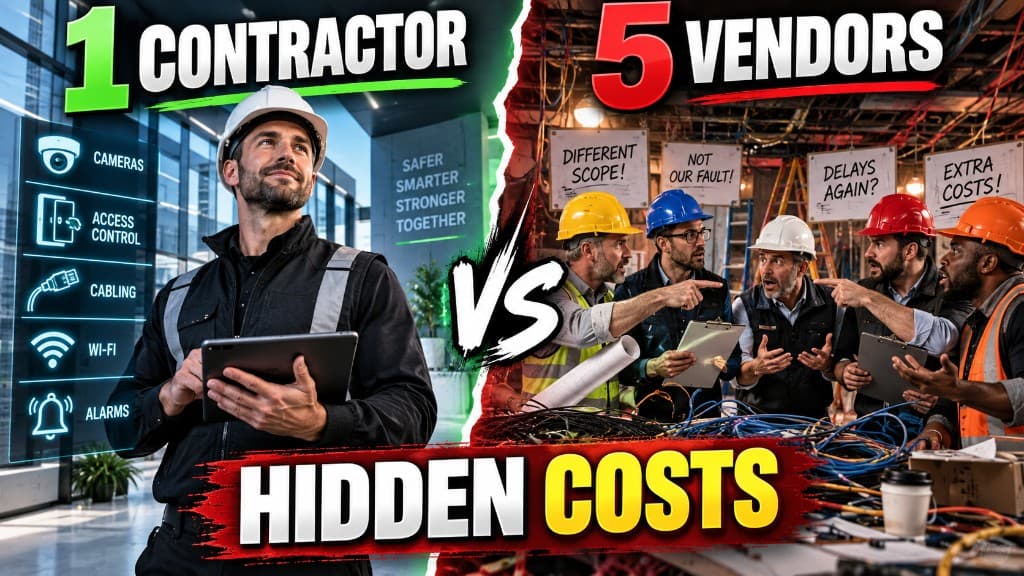
Splitting cameras, cabling, access, networking handoff, and after-hours support across five vendors rarely saves money—it moves cost into coordination, change orders, warranty gaps, and schedule slip. For Facilities, Ops, and Procurement buying commercial security and low-voltage work in Southern California, the decision is who owns the outcome when systems that share pathway, closets, and cutover dates fail to line up.
One accountable low voltage contractor does not eliminate every trade. It does collapse the handoffs that usually create orphaned pathway, door-day chaos, and "not my warranty" tickets after go-live.
Ready to map where your current stack is leaking time and accountability? Request a Facility Security Modernization Review via our contact page or call 1-800-276-0415.
Quick Answer: What Does Split Accountability Actually Cost?
When you hire separate vendors for video, access, structured cabling, outdoor pathway, and post-install support, you typically pay four hidden costs:
- Coordination tax — your team becomes the general contractor for handoffs nobody priced
- Change-order friction — each vendor's exclusion becomes another PO when assumptions collide
- Warranty gaps — failures at cable–device–software boundaries get bounced between tickets
- Schedule drag — five calendars, five crews, five "we're waiting on them" delays
Bold takeaway: the sticker price of five specialty quotes can look lower than one integrated package. The total cost of ownership (TCO) often flips once you count Facilities hours, rework, and downtime risk.
This article is for commercial buyers who already know what low-voltage work covers and are past a pure bid bake-off. The question here is accountability architecture: one owner versus a fragmented stack. If you are still normalizing line items across proposals, start with how to compare low voltage contractor bids —then come back to who owns the seams.
Why Facilities and Procurement Feel This Pain First
Ops notices when a door reader fails during a shift change. IT notices when PoE and VLANs were never aligned. Procurement notices when three change orders land after a "complete" award. Facilities feels all of it—because they own the building, the access windows, and the vendor list.
On SoCal commercial sites—warehouses and distribution floors in the Inland Empire, light manufacturing corridors, office campuses in LA and Orange County, and multi-building footprints down toward San Diego—the same pattern shows up:
- Camera vendor assumes drops exist
- Cabling vendor was never told about yard poles or gate readers
- Access vendor arrives before power supplies and strike prep are ready
- Nobody owns after-hours escalation once the last invoice is paid
Split vendors can work when scopes are surgically clean and one internal owner has time to run the matrix. Most Facilities teams do not have that spare capacity. Watch for the same seam language that shows up in camera quote red flags that turn into change orders.
The Five-Vendor Model (and Where Handoffs Break)
A common commercial split looks like this:
| Specialty | Typical owner | Breaks when… |
|---|---|---|
| IP cameras / NVR or cloud video | Security integrator A | Pathway or PoE was never in their quote |
| Access control / doors | Integrator B | Door prep, power, and network edge sit elsewhere |
| Structured cabling / fiber | Cabling contractor C | Device schedule arrived after pathway was pulled |
| Outdoor / yard / gate pathway | Electrical or specialty D | GC and LV never agreed who owns conduit |
| Monitoring / warranty / MACs | Vendor E (or none) | Tickets bounce across install warranties |
None of those trades is "wrong." The hidden cost is the space between them.
Coordination: Your Team Becomes the Integrator
Every interface needs a decision:
- Who labels the drop that serves both a camera and a future AP?
- Who owns firestop when a sleeve is shared?
- Who schedules the IDF shutdown that cameras, doors, and switches all need?
- Who updates as-builts when Vendor B moves a device Vendor C already documented?
In a fragmented model, Facilities or Ops becomes the project manager. That labor rarely appears on any vendor's proposal—but it shows up in overtime, missed dock windows, and delayed cutovers.
A single low voltage contractor still coordinates with electricians and GCs. The difference is fewer soft boundaries inside the low-voltage stack itself: cable, cameras, access, and closet work can share one schedule, one device list, and one acceptance package. End-Point Wireless frames that stack as part of commercial security system installation—not five unrelated POs.
Change Orders: Exclusions Multiply at the Seams
Change orders are not always "scope creep." Often they are seam gaps:
- Access hardware included; door power and maglock prep excluded
- Cameras included; outdoor conduit and pole mounts excluded
- Cabling included for known drops; late-added yard cameras not on the pathway plan
- Software licenses assumed owner-furnished; nobody confirmed who buys or renews them
Each vendor protects their margin with exclusions. That is rational. When five vendors do it independently, your change-order surface area multiplies. Procurement then spends weeks clarifying who is responsible for work that should have been one coordinated package. Pair every award with the must-haves in what a commercial camera quote should include so pathway and licenses are not soft assumptions.
Bold takeaway: count exclusions and interface assumptions, not just base dollars. Seam gaps are where TCO hides.
Warranty Gaps: Failures Love Boundaries
After go-live, the expensive problems often sit on a boundary:
- Camera online, but intermittent video tied to a marginal cable or PoE budget
- Reader online, but door won't release because power supply or strike was another trade
- System "works" until a switch port, VLAN, or patch is moved and nobody owns the edge
With split vendors, each ticket starts with "that's their part." Facilities burns days proving which side of the RJ45 owns the failure. With one accountable low voltage partner, escalation has a single throat to choke—and a single warranty conversation.
For door hardware and reader work specifically, keep access in the same accountability model as the rest of the stack; see how End-Point Wireless approaches access control installation as part of a facility plan, not an orphaned door PO. Yard gates and vehicle entries often need the same unified ownership—see vehicle gate access.
Scheduling: Five Calendars Beat One Plan
Live commercial sites punish fragmented schedules:
- Dock blackouts and freight peaks
- After-hours only in office towers
- Lift days that need clear truck lanes
- IDF work that cannot collide with production IT freezes
Five vendors means five preferred windows. One missed predecessor (pathway not ready, strike not set, switch ports not live) cascades. Your Ops calendar fills with "waiting on them" notes that never appear as a line item—until overtime and delayed go-live do.
One low voltage contractor can still slip. But one critical path is easier to manage than five loosely coupled ones. Closet and network readiness belong in that path—coordinate early with network setup and configuration so PoE and VLANs are not day-of surprises.
What "One Low Voltage Contractor" Should Actually Own
Consolidation is not a slogan. It is a written accountability map. For commercial Facilities and Procurement, a single low voltage contractor should typically own:
- Device schedule — cameras, readers, drops, outdoor points, closet terminations
- Pathway plan — what uses existing route vs new pulls, outdoor runs, labeling standards
- Install sequence — cabling → devices → programming → cutover → training
- Interface list — what electrician, GC, IT, and locksmith still own (in writing)
- Closeout package — testing, as-builts, admin handoff, warranty contact
- Post-install MAC path — who moves a camera or adds a door after acceptance
They should not pretend to replace line-voltage electrical, GC walls and finishes, or your IT policy decisions. Clear boundaries outside the low-voltage stack are healthy. Fuzzy boundaries inside it are expensive.
Pathway and closet quality are where consolidation pays off fastest—especially when cameras, access, and data share the same plant. That is why commercial structured cabling belongs in the same conversation as devices, not as an afterthought RFP. When you are deciding repair vs replace vs modernize across that stack, use the commercial security system upgrade checklist.
A Practical TCO Lens for Procurement (Without Fake ROI Math)
You do not need invented savings percentages to compare models. Use a decision lens Facilities and Finance can share.
Score Both Models on the Same Five Questions
- Who owns the device-to-closet path in writing?
- How many vendors must agree before a cutover date is real?
- Where do warranties stop—and who documents the seams?
- How many internal hours will Facilities spend coordinating handoffs?
- If a dock camera and a gate reader both fail on Monday, is there one escalation path?
If Model A (five vendors) wins on base price but loses on questions 1–5, you are not buying a cheaper outcome—you are buying a cheaper proposal and a more expensive program.
Where Consolidation Tends to Win
- Sites adding cameras + access + pathway in one phase
- Multi-closet or multi-building footprints
- Live logistics and manufacturing floors where schedule risk is expensive
- Teams with lean Facilities bandwidth
Logistics and industrial environments feel split accountability hardest because freight flow, yard coverage, and door control share the same closets and the same downtime cost. End-Point Wireless works regularly with those buyers—see our logistics industry page and manufacturing page for how facility context shapes the stack on distribution and industrial floors.
Where a Managed Multi-Vendor Model Can Still Make Sense
- You already have a strong internal PM and a clean interface matrix
- One specialty is highly constrained (e.g., a mandated monitoring provider)
- You are only refreshing one subsystem with zero pathway touch
Even then, write the seams. Unwritten handoffs are where TCO leaks.
SoCal Site Realities That Punish Split Vendors
Southern California commercial work adds friction that generic national quotes underprice:
- High-bay and yard work — lifts, outdoor UV pathway, gate approaches
- Live operations — after-hours cuts, dock blackouts, tenant quiet hours
- Campus sprawl — MDF/IDF hops across LA, OC, IE, and SD footprints
- Heat and dust — terminations and outdoor mounts that fail early if rushed
Teams based in the Inland Empire corridor—where End-Point Wireless operates from Ontario—see these conditions constantly on warehouses, plants, and multi-building sites. The lesson for Procurement is simple: labor coordination and pathway ownership matter as much as hardware SKUs.
Decision Checklist: One Contractor vs. Five Vendors
Use this before you issue POs:
- One master device and location schedule shared with every bidder
- Pathway and outdoor runs named as include / exclude / owner-furnish
- Door power, strikes, and network edge ownership written down
- Single cutover and acceptance criteria (not five "substantial completion" emails)
- Warranty and escalation contacts listed by subsystem and by seam
- Internal Facilities hours estimated for coordination under each model
- Post-install MAC process defined before go-live
If you cannot check most of these under a five-vendor plan, consolidation is not a preference—it is risk control. Demand survey artifacts—not a sales walk—using what a site survey should put on a commercial camera quote.
How End-Point Wireless Approaches Accountability
End-Point Wireless is a commercial low voltage contractor focused on making cameras, access, cabling, and facility handoff work as one program—not five disconnected invoices. We serve Facilities, Ops, and Procurement teams across Southern California who need clear ownership from survey through cutover.
We will still tell you what belongs with your electrician, GC, or IT team. Clarity outside the stack protects your budget as much as consolidation inside it.
Learn more about End-Point Wireless or start a live scope conversation through the contact options below.
Next Step for Facilities, Ops, and Procurement Teams
Request a Facility Security Modernization Review. Call 1-800-276-0415 or reach us via contact. Bring your current vendor list, open warranties, and the systems that share closets—we will help you see where split accountability is costing schedule and trust. More guidance lives on the Endpoint Wireless blog.
FAQs
Is one low voltage contractor always cheaper than five specialty vendors?
Not always on day-one sticker price. Consolidation often wins on TCO when you count Facilities coordination hours, seam change orders, warranty bounce, and schedule risk. Compare models with the same device schedule and the same include/exclude rules—not five unrelated quotes.
What should stay outside a low voltage contractor's scope?
Line-voltage electrical, general construction (walls, penetrations requiring GC/structural work), fire-alarm life-safety programming unless specifically contracted, and your internal IT/security policy decisions. Write those boundaries so consolidation inside the low-voltage stack does not blur into trades that need different licenses and owners.
How do warranty gaps show up after a multi-vendor install?
Usually as intermittent failures at cable–device–network boundaries, or door issues that sit between hardware, power, and software. Each vendor points to another. Ask for a written seam map and a single escalation owner before acceptance—or choose one accountable partner for the shared stack.
Can we consolidate later if we already have five vendors?
Yes. Start with the next phase that touches pathway, closets, or multiple subsystems. Require one master schedule, one cutover plan, and clear warranty handoff for anything that remains with incumbent vendors. Do not wait for a full rip-and-replace to fix accountability.
What should Procurement put in the RFP to reduce split-accountability risk?
Require a single device schedule, pathway assumptions, interface ownership (electrician/GC/IT), closeout deliverables, and post-install MAC/escalation contacts. Score proposals on accountability and schedule realism—not only unit price.
Who should own the vendor matrix internally—Facilities, Ops, or Procurement?
Procurement should own commercial terms; Facilities or Ops should own the operational matrix (access windows, cutover criteria, escalation). One internal owner must maintain the living interface list. Without that, even a single contractor relationship drifts.
Does vendor consolidation matter more for logistics and manufacturing sites?
Often yes, because live freight, yard coverage, high-bay installs, and door control create expensive schedule collisions. Office campuses feel coordination pain too—especially multi-IDF footprints—but downtime and lift logistics tend to hit warehouses and plants harder. See also warehouse security cameras in the Inland Empire.
What is a Facility Security Modernization Review?
It is a structured conversation with End-Point Wireless about your current cameras, access, cabling, vendor seams, and facility constraints—so you can see where one accountable low voltage contractor would reduce handoff risk. Call 1-800-276-0415 or use the contact page to request one.
Tired of split-vendor handoffs?
Ask about a Facility Security Modernization Review, or get a quote for commercial security system installation across Southern California