How to Compare Low Voltage Contractor Bids Without Getting Burned by Change Orders
Share this article:
30 sec. overview
The lowest low voltage contractor bid is not the cheapest if pathway, lifts, and exclusions are missing. Force every bidder onto the same device schedule, pathway assumptions, lift/access windows, exclusions sheet, and closeout package—then compare dollars. Normalize scope first or the "win" on bid day becomes the change-order stack at cutover.
The lowest low voltage contractor bid is not the cheapest if pathway, lifts, and exclusions are missing. When Facilities, IT, Ops, or a GC line up three commercial proposals in Southern California, the real comparison is not camera count or door count—it is whether every bid prices the same scope, the same site realities, and the same owner-furnished boundaries. Change orders almost always come from soft language, not from "unexpected cameras."
Use this guide as a bid-literacy checklist before you PO. It is built for warehouses, plants, offices, and multi-building sites from Los Angeles and Orange County through the Inland Empire and San Diego—not for a residential alarm bake-off.
Ready for a side-by-side quote walkthrough? Request a Facility Security Modernization Review at contact or call 1-800-276-0415. Pair this checklist with camera quote red flags that turn into change orders when video is the primary package on the table.
Quick Answer: How Do You Compare Low Voltage Contractor Bids Fairly?
Force every bidder onto the same apples-to-apples grid before you score price:
- Same device schedule — cameras, readers, drops, fiber runs, and outdoor points listed by location
- Same pathway assumptions — existing conduit/tray vs new pulls, outdoor/yard runs, firestop, labeling
- Same access hardware — lifts, boom days, after-hours windows, and high-bay work
- Same exclusions list — written include / exclude / owner-furnish for power, network, door prep, and GC work
- Same closeout package — testing, as-builts, training, and who owns punch until acceptance
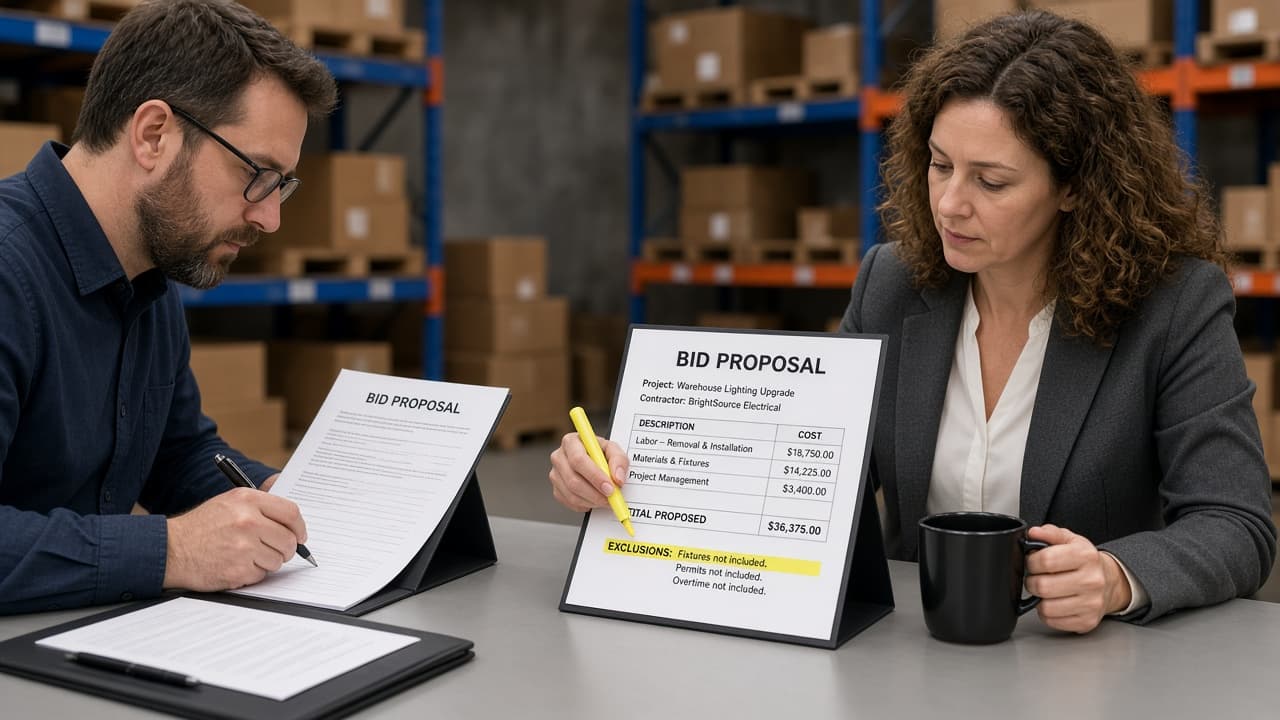
If Bidder A prices hang-and-power on existing drops and Bidder B prices new pathway, lifts, and closet work, you are not comparing two low voltage contractor numbers—you are comparing a partial install to a finished outcome.
Bold takeaway: normalize scope first, then compare dollars. Otherwise the "win" on bid day becomes the change-order stack at cutover.
Why SoCal Commercial Bids Diverge So Fast
Southern California commercial sites punish vague proposals. High-bay logistics floors, live dock lanes, multi-IDF campuses, outdoor yards, and hard-lid offices all change labor math. A desk bid built from a floor plan alone often assumes:
- Spare PoE and spare ports in every closet
- Open ceilings and clear pathway
- Daytime labor only
- No boom over truck lanes
- Door frames and strikes already ready
Those assumptions fail in Ontario, Fontana, Irvine, Long Beach, and San Diego alike. The vendors who priced the optimistic version look cheapest until the site walk catches up. End-Point Wireless works from the Inland Empire base in Ontario—the same corridor where pathway and lift gaps show up on real commercial scopes. Demand survey artifacts before you trust a desk number; see what a site survey should put on your commercial camera quote.
Who Should Own the Comparison Matrix?
- Facilities / Ops — site access, after-hours windows, dock blackouts, tenant quiet hours
- IT — switch ports, VLANs, PoE budget, credential source of truth
- Security / leadership — must-cover doors and camera investigation use cases
- GC (when present) — walls, penetrations, coordination windows, and who owns patch/paint
One owner should maintain the master matrix. Hand it to every bidder so clarifications land in addenda—not in hallway conversations.
Step 1: Build One Device and Location Schedule
Do not let bidders invent their own camera and door lists. Publish one schedule and require every low voltage contractor to price against it.
What Belongs on the Schedule
- Cameras — ID, location, indoor/outdoor, height class, night/low-light need, purpose (dock dispute, lobby, cage, aisle)
- Access openings — door ID, reader type, strike/mag ownership note, free egress requirement
- Data drops — device drops vs workstation drops, Cat rating if specified
- Fiber / backbone — MDF↔IDF counts and spare strands if known
- Outdoor points — poles, gates, canopies, parking approaches
If the schedule is incomplete, every bidder will fill gaps differently—and you will reward the most optimistic filler.
For camera and panel work that sits inside a broader security stack, keep the schedule aligned with how you would scope security system installation—coverage and pathway named together, not cameras as a standalone SKU list. The seven must-haves in what a commercial camera quote should include apply to the camera rows on that same schedule.
Step 2: Force Pathway into the Price (or into Owner-Furnish)
Pathway is where commercial low voltage contractor bids quietly diverge. "Cabling included" can mean:
- Terminate and patch existing drops only
- Pull new Cat6 in open tray on day shift
- New conduit, sleeves, firestop, outdoor UV-rated pathway, and labeling standards
Those are not the same job.
Pathway Questions Every Bidder Must Answer in Writing
- Which runs use existing pathway, and which need new pulls?
- Who owns conduit, sleeves, pull boxes, and firestop?
- Are outdoor yard and gate pathways included—or cameras only?
- Is labeling, testing, and as-built documentation included?
- What happens when a ceiling or wall condition blocks the assumed route?
When pathway is real scope—not a hope—tie it to structured cabling expectations: horizontal copper, fiber backbone, closet hygiene, and documentation. Logistics docks and manufacturing high-bays are especially unforgiving; see EPW's logistics context for why traffic, dust, heat, and lift access change pathway cost more than device count on docks and industrial floors. Closet capacity often needs MDF/IDF buildout and network setup named alongside the pull.
Bold takeaway: if pathway is "TBD" or "allowance as needed" with no number, treat that line as a future change order.
Step 3: Price Lifts, Height, and Access Windows Explicitly
Lifts are not a footnote. They are often the difference between a hallway dome and a real warehouse or plant install.
Lift and Access Items to Normalize Across Bids
- Scissor vs boom requirement by location
- Number of lift days included (and overtime rate after)
- Who provides the lift—contractor or owner
- High-bay mounts, weather-rated outdoor mounts, and vibration considerations
- After-hours or weekend labor for live docks and occupied offices
- Escort, badging, and safety orientation time
A Fontana dock camera over live truck lanes is not the same labor line as an Irvine corridor dome. If one bid includes boom days and another assumes "owner provides access equipment," score them separately—then decide which assumption you actually want. Outdoor and lot scope should also line up with parking lot cameras and yard approaches when those zones are in play.
After-Hours and GC Coordination
Ask each bidder:
- What labor rate applies outside standard hours?
- Which tasks must be after-hours (door cutovers, network changes, lobby readers)?
- Who coordinates with the GC for penetrations, patch, and inspection holds?
Change orders love silent assumptions about "we'll do it Saturday for free."
Step 4: Put Exclusions and Owner-Furnished Work on One Page
Apples-to-apples comparison fails when exclusions hide in the fine print of only one proposal. Require a shared exclusions sheet every bidder completes.
Typical Include / Exclude / Owner-Furnish Buckets
| Bucket | Usually contractor | Often owner / other trade | Red-flag soft language |
|---|---|---|---|
| Device hang & terminate | Yes | — | "Labor included" with no pathway note |
| New pathway / conduit | If scoped | Sometimes GC / electrician | "Pathway TBD" |
| PoE switches / injectors | If scoped | Often IT owner-furnish | "Plug into existing switch" |
| VLAN / firewall changes | Coordination | Usually IT | "Network by others" with no date |
| Door strikes / prep | Sometimes | Locksmith / GC | "Door hardware excluded" buried |
| Line-voltage power | Rarely | Electrician | Assumed receptacles exist |
| Lifts | If scoped | Sometimes owner | Silent omission |
| Patch / paint / ceiling tile | Rarely | GC / Facilities | Not mentioned at all |
| Training & as-builts | Should be yes | — | "Training upon request" |
For door packages, force clarity the same way you would for access control installation: reader, cabling, panel, programming, strike ownership, and power ownership named per opening—not one lump "access included." Avoid the traps covered in common access control mistakes.
How to Neutralize Exclusion Games
- Convert every soft phrase into include, exclude, or owner-furnish with a name and deadline
- Cap allowances and define what burns them (lift days, conduit LF, switch ports, after-hours hours)
- Require unit rates for adds (extra camera, extra door, extra drop) so late changes are priced, not invented
- Reject "industry standard" as a specification—write the actual assumption
If Bidder C's price is lowest because power, network, lifts, and outdoor pathway are all "by others," that is not value. That is risk transfer.
Step 5: Compare Closeout, Not Just Install Day
Change orders also appear after the crew leaves—when Facilities cannot find a cable, IT cannot trust labeling, or Ops never got training.
Closeout Checklist to Score on Every Bid
- Test results (copper/fiber) delivered to IT / Facilities
- Labeled patch fields and as-built drawings
- Admin training for Facilities / Security / HR workflows
- Punch process and warranty start trigger
- Who owns remote support handoff after acceptance
A bid that underprices closeout often "finishes" on hang day and leaves you with an unfinished system. Score documentation and training as hard requirements, not goodwill.
A Practical Bid-Comparison Matrix You Can Copy
Build a spreadsheet with one row per risk item and one column per bidder. Score Included / Excluded / Owner / Unclear—then force Unclear to resolve before award.
Minimum rows:
- Device schedule matches owner list
- Indoor pathway priced
- Outdoor / yard pathway priced
- Lift days priced
- After-hours labor priced or rate sheet attached
- PoE / switch capacity addressed
- VLAN / IT responsibilities named
- Door hardware split named
- Electrical power split named
- Firestop / penetrations named
- Labeling + testing + as-builts included
- Training included
- Unit rates for adds attached
- Exclusions list attached and signed
Award only after Unclear cells are gone. Price ranking without that cleanup is theater.
Red Flags That Almost Always Become Change Orders
Watch for these patterns across SoCal commercial low voltage contractor proposals:
- Lump-sum "system + labor" with no task breakdown
- Large TBDs after a desk quote (photos/floor plan only)
- Outdoor cameras listed without mounts, pathway, or lifts
- "PoE plug-and-play" with no closet capacity check
- Access "included" without a door matrix
- Allowances with no dollar or burn rule
- Exclusions only in a PDF appendix nobody on the evaluation team read
- No unit rates for inevitable adds during construction
None of these prove a vendor is bad. They prove the proposal is incomplete. Incomplete proposals become change orders when the site is already mobilized. For camera-specific versions of the same patterns, use camera quote red flags.
How GCs and Facilities Should Run the Clarification Round
Before final award:
- Issue the same Q&A addendum to every bidder
- Require revised pricing where clarifications change scope
- Hold a short joint call only if written answers conflict
- Re-score the matrix—do not "remember" who seemed more helpful
- Freeze scope in the PO / subcontract language
Verbal "we'll take care of it" has no value at invoice time. Put the care into the document.
What "Good" Looks Like on a Normalized Bid
A strong commercial bid from a low voltage contractor usually looks slightly higher than a hang-only proposal—and much clearer:
- Device schedule matches yours
- Pathway and outdoor work are priced or explicitly owner-furnished
- Lift days and after-hours rates are visible
- IT and electrical boundaries are named
- Closeout deliverables are listed
- Unit rates exist for controlled adds
That package is easier to defend to Finance because the number you approve is closer to the number you will actually spend. When cameras are the headline package, also keep commercial camera installation scope honest about pathway and licenses—not just headcount.
FAQ: Comparing Low Voltage Contractor Bids
Why do three low voltage contractor bids differ so much on the same building?
They usually price different assumptions about pathway, lifts, after-hours labor, network readiness, and door hardware—not different camera brands alone. Normalize those assumptions before you compare price.
Should I always pick the middle bid?
Not automatically. Pick the bid that matches your written scope with the fewest Unclear cells and the cleanest exclusions. A middle price with missing outdoor pathway can still burn you.
Are allowances okay on commercial low voltage work?
Yes—when they are named, numbered, and tied to a burn rule (for example, lift days or conduit feet). An open-ended "pathway allowance as needed" is usually a change-order placeholder.
Who should own PoE switches and VLAN changes?
Decide before award. Many SoCal Facilities teams keep VLAN and directory work with IT and ask the contractor to coordinate. Whatever you choose, write owner, deadline, and what happens if ports are short.
How do I compare bids when a GC is already on site?
Publish coordination rules: who cuts penetrations, who firestops, who patches, and which windows are available. Require every low voltage bidder to price against the same GC rules so you are not comparing a GC-friendly schedule to a fantasy schedule.
What if one vendor refuses to unbundle labor?
Treat that as a risk signal. Without a task breakdown, you cannot tell whether pathway, lifts, testing, and training are inside the number. Ask for clarification in the addendum round; if they still will not unbundle, score the opacity.
Do I need a site walk before final award?
For warehouses, plants, multi-building campuses, and any outdoor yard scope, yes—especially if the first round was desk-based. A post-survey true-up before PO is cheaper than discovering boom and conduit gaps after mobilization.
What should I do right now if bids are already on my desk?
Build the matrix, highlight Unclear and Excluded rows, issue one clarification addendum to all bidders, and re-rank only after revised answers land. Do not award on original paper if pathway and lifts are soft.
Next Step: Get an Apples-to-Apples Review Before You PO
If you are comparing commercial low voltage contractor proposals for a SoCal warehouse, plant, office, or multi-site campus, do not let the lowest line item decide the project. Normalize device schedule, pathway, lifts, exclusions, and closeout—then choose the number that matches reality.
Request a Facility Security Modernization Review with End-Point Wireless: contact or 1-800-276-0415. Bring the bids you already have; the goal is a fair comparison and a scope you can defend—not a surprise change-order stack after cutover. Bring stakeholder questions to the review—scope clarity beats a low number that cannot survive pathway and lift reality. More guidance lives on the Endpoint Wireless blog.
Want an apples-to-apples bid review?
Ask about a Facility Security Modernization Review, or get a transparent quote for commercial security system installation across Southern California