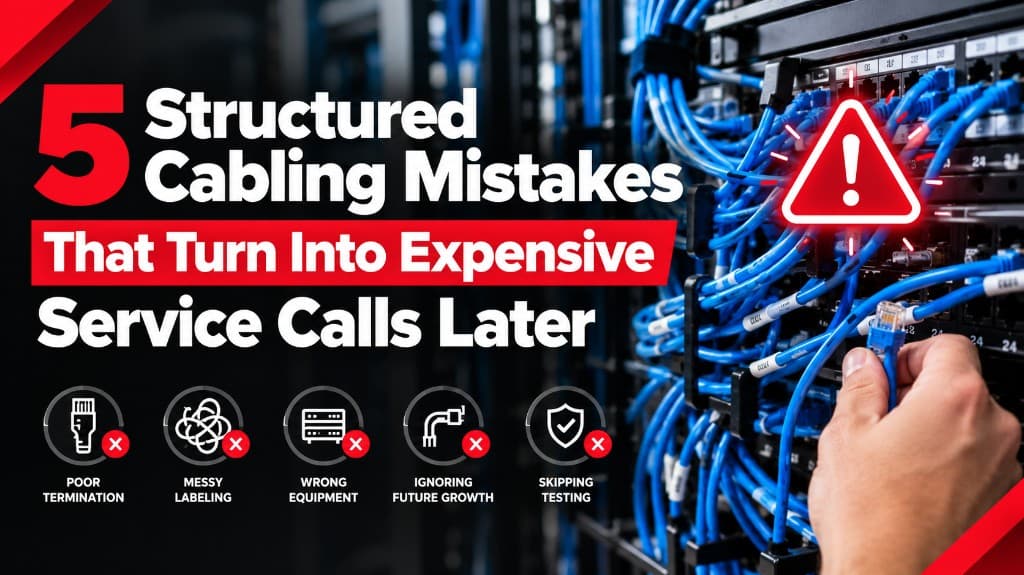
5 Structured Cabling Mistakes That Turn Into Expensive Service Calls Later
Share this article:
30 sec. overview
Most expensive cabling service calls are not “mystery failures.” They trace back to predictable structured cabling contractor mistakes—or buyer SOWs that never required the opposite. The five that show up again and again: inconsistent labeling, skipped or unverifiable testing, pathway and fill overload, thin closeout documentation, and treating cameras/access as an afterthought. Fix those in design and acceptance, and move-add-change (MAC) work stops being a scavenger hunt.
If you run IT, facilities, or procurement for warehouses, plants, or multi-tenant sites across the Inland Empire, Orange County, Los Angeles, or San Diego, you have likely paid for a truck roll that was really a documentation problem. This guide is a prevention checklist for commercial buyers—not a DIY cable-pull tutorial, and not a promise of labor savings percentages or case-study ROI.
Why “It Works Today” Is Not the Same as “It Is Maintainable”
On walkthrough day, green link lights look like success. Six months later, a camera add, AP refresh, or tenant churn opens a ceiling full of unlabeled bundles. IT loses hours. Facilities burns access windows. Procurement gets change-order noise that a better structured cabling SOW would have prevented.
Service calls get expensive when discovery time exceeds repair time. The mistakes below create discovery time on purpose—even when nobody intended to. For how bid language creates (or prevents) that cost later, see how to compare low voltage contractor bids without change-order burn.
Buyer control: Write prevention into the contract. Require labeling schemes, per-link tests, pathway photos, and acceptance tied to documentation—not only to “drops live.”
Mistake 1: Inconsistent or Missing Labeling
What it looks like in the field
- Outlet labels that do not match panel ports
- Panels labeled with marker that fades or gets covered by patch cords
- IDF naming that differs from the building drawings IT actually uses
- Spare ports undocumented, so the next crew “guesses” capacity
Why it becomes a service call
Every MAC starts with “which port is this?” Without a scheme, technicians tone cables, open ceilings, and burn hours that should have been a 20-minute patch. Multi-building campuses amplify the cost: the same ambiguity repeats at every closet. That is the same accountability gap covered when you choose one low voltage contractor vs. five vendors.
What to require instead
- A written labeling convention (building / floor / IDF / panel / port / outlet)
- Labels on both ends that match the convention
- An outlet-to-panel matrix delivered at closeout
- Photo samples of labels in the field before final acceptance
Reject “we label as we go” with no documented scheme. Labeling is a deliverable, not a personality trait of the crew lead.
Mistake 2: Skipping Real Test Results (or Accepting “All Passed”)
What it looks like in the field
- No per-link test file—only a verbal “everything tested fine”
- A one-page summary with no circuit IDs
- Tests that do not match the labels on the wall
- Fiber strands paid for but never shown in results
Why it becomes a service call
Intermittent drops, CRC errors, and “camera keeps dropping” tickets often start as marginal links that never had a permanent-link record. Without tests, you cannot tell whether the problem is cable, patch, switch, or device. You pay to rediscover what acceptance should have proved.
What to require instead
- Per-link copper results for every paid permanent link, IDs matching labels
- Fiber results for every paid strand/pair as specified in the SOW
- Tester identification, dates, and pass/fail detail you can archive
- Desk review by IT before retainage release
Buyer rule: if a drop is on the invoice, it is on the test report—or it is not accepted. Pair this with the same discipline you would use for security system installation endpoints that depend on those drops. Media choices that affect test scope are covered in the Cat6 / Cat6A / fiber decision guide.
Mistake 3: Overloading Pathways and Ignoring Future Pulls
What it looks like in the field
- Conduit and sleeves packed beyond practical fill
- Cable tray with no logical separation for future security or Wi-Fi adds
- Ceilings closed with no photos of routes
- No spare capacity notes for the next camera or AP wave
Why it becomes a service call
The next project cannot pull without demolition, after-hours reopen, or risky “just one more cable” jam-ins that create faults. Facilities pays for access; IT pays for delay; the “cheap” initial install becomes the expensive constraint.
Logistics docks and manufacturing floors feel this quickly: camera and access adds are not optional forever, and pathway was never sized for them. Plan pathways as a shared backbone—see shared pathways for cameras, access, and alarms.
What to require instead
- Pathway design that accounts for known near-term security, Wi-Fi, and access adds
- Spare capacity notes in closeout (tray, conduit, panel ports, rack RU)
- Pathway photos before concealment
- Explicit discussion of sleeves between MDF/IDF and to exterior poles or yards when video is planned
Do not accept a plant that is “full on day one” unless the SOW intentionally made it a one-generation install—and even then, document that choice.
Mistake 4: Thin Closeout (No As-Builts, No Ownership, No Archive)
What it looks like in the field
- Bid drawings stamped as “as-builts”
- No rack elevations reflecting final gear
- Warranty docs missing or filed only with the contractor
- Nobody named as owner of the cable plant records
Why it becomes a service call
When the original crew is gone, tribal knowledge leaves with them. The next RFP starts with a full rediscovery survey. Tenant disputes and insurance questions lack evidence of what was installed. Procurement cannot prove deliverables.
What to require instead
Treat closeout as a buyer control:
- True as-builts reflecting field conditions
- Test packages tied to labels
- Labeling scheme + schedules
- Pathway/enclosure photos
- Warranty and product documentation with contacts
- Named archive owners in IT and facilities
Tie final payment / retainage to package acceptance. If you need a deeper acceptance checklist, use the same mindset as a formal cabling closeout review—not a handshake walkthrough—and the same completeness bar as what a commercial low voltage contractor actually handles.
Mistake 5: Treating Cameras and Access Control as “Later”
What it looks like in the field
- Data drops only at desks; no plan for doors, docks, or parking poles
- IDFs with no RU or power headroom for security appliances
- No VLAN or pathway conversation with Security before ceilings close
- Access readers planned after finishes—then surface raceway appears
Why it becomes a service call
Security projects arrive on a compressed timeline after an incident. Crews open finished ceilings, add surface conduit, and disrupt operations because the plant was never designed as a shared low-voltage backbone. You pay premium labor for what should have been rough-in.
What to require instead
During cabling design, ask:
- Which doors will need readers and identify cameras in the next 12–24 months?
- Which docks, yards, and entries need PoE and pathway for video?
- Do closets have power, cooling, and RU for controllers or appliances?
- Are exterior pulls (poles, gates) scoped or at least sleeved?
Coordinate early with access control installation and video plans so the structured plant is the backbone—not the obstacle. Use the door-by-door access control checklist during design reviews. For multi-site logistics environments, standardize closet expectations so each building does not reinvent pathway gaps—see single-site vs. multi-site centralized visibility.
How These Five Mistakes Stack (And Inflate Tickets)
Real service tickets rarely have one cause:
- Unlabeled panel → tone-out time
- No test record → cannot isolate cable vs. switch
- Full conduit → cannot add a drop without reopen
- No as-built → wrong closet assumed
- Security afterthought → emergency surface install
Prevention is cheaper than stacked discovery. Put all five controls in the SOW even if the bid looks slightly higher on paper—compare lifecycle MAC cost, not only rough-in price. When the plant is already aging, triage with the commercial security system upgrade checklist.
Buyer RFP Language That Prevents the Five Mistakes
Include language substantially like:
- Contractor shall deliver a documented labeling scheme and label both ends accordingly.
- Contractor shall provide per-link test results matching labels for all paid copper/fiber links.
- Pathway design shall include spare capacity notes and photos before concealment.
- Closeout shall include as-builts, tests, schedules, photos, and warranty docs before retainage release.
- Design review shall include known security/access/Wi-Fi adjacency for the planning horizon.
Ask bidders to price documentation as a line—not as an optional courtesy.
SoCal Context: Why These Mistakes Hit Harder Here
Southern California commercial sites—IE distribution, OC industrial parks, LA multi-building campuses, SD light manufacturing—see fast TI churn, phased security adds, and after-hours access windows that make rediscovery expensive. A clean plant with tests and labels shortens every camera, AP, and reader project that follows.
When you evaluate a structured cabling contractor, evaluate maintainability deliverables with the same seriousness you give cable category and labor rates. Long runs from office MERs to dock walls often need early fiber optic cabling or intermediate IDFs—plan that before pathways close.
Frequently Asked Questions
What are the most expensive structured cabling mistakes after install?
In practice: missing labels, missing tests, overfilled pathways, weak closeout, and no security/access planning. Each turns a simple MAC into discovery labor—and they often stack on the same ticket.
How do we verify labeling before we accept a job?
Require a written scheme, sample field photos, and a matrix that matches outlet IDs to panel ports. Spot-check a sample of drops during acceptance. If IDs do not match, do not accept.
Are cable tests really necessary if everything links up?
Yes. Link lights do not equal a documented permanent-link result. Tests give you an archive for intermittent faults and a baseline when devices or switches change later.
How much spare pathway capacity should we leave?
Enough for your known planning horizon (cameras, APs, access, tenant churn)—documented in closeout. “Full on day one” is a choice; make it explicit and accept the future reopen cost if you choose it.
What belongs in a cabling closeout package?
As-builts, per-link tests, labeling documentation, pathway/enclosure photos, warranty/product docs, and schedules with spare-capacity notes. Name archive owners in IT and facilities.
Should security cameras and access be part of the cabling design meeting?
If those systems are likely within your planning horizon, yes. Rough-in and closet capacity decisions are far cheaper before ceilings close than during an incident-driven retrofit.
Who should own cabling documentation after the contractor leaves?
Joint ownership: IT for identifiers and tests, Facilities for pathways and access, Procurement for contractual completeness and warranty filing. One orphaned shared drive folder is not ownership.
How do we compare cabling bids fairly?
Compare SOW completeness—labeling, testing, closeout, pathway spare, security adjacency—not only drop count and hourly labor. The cheapest rough-in often produces the most expensive service calls.
Next Step: Facility Security Modernization Review
If your closets are unlabeled, your last project left thin paperwork, or your next camera/access wave has nowhere to land, fix the plant plan before the next emergency ticket.
Request a Facility Security Modernization Review with End-Point Wireless. We help IT, Facilities, and Procurement align commercial structured cabling with security and network readiness—so MACs stop starting with a scavenger hunt.
Call 1-800-276-0415 or contact our team. Related: structured cabling · security system installation · access control installation.
Planning a maintainable cable plant?
Ask about a Facility Security Modernization Review, or get a quote for commercial structured cabling across Southern California