What Is OTDR Testing—and Why Should It Be in Your Fiber Installation Closeout Package?
Share this article:
Fiber jobs do not usually fail in the sales deck. They fail months later when a strand will not light, a label does not match a panel, or nobody can prove whether a fault is in a splice, a connector, or a mid-span bend from a rushed pull.
30 sec. overview
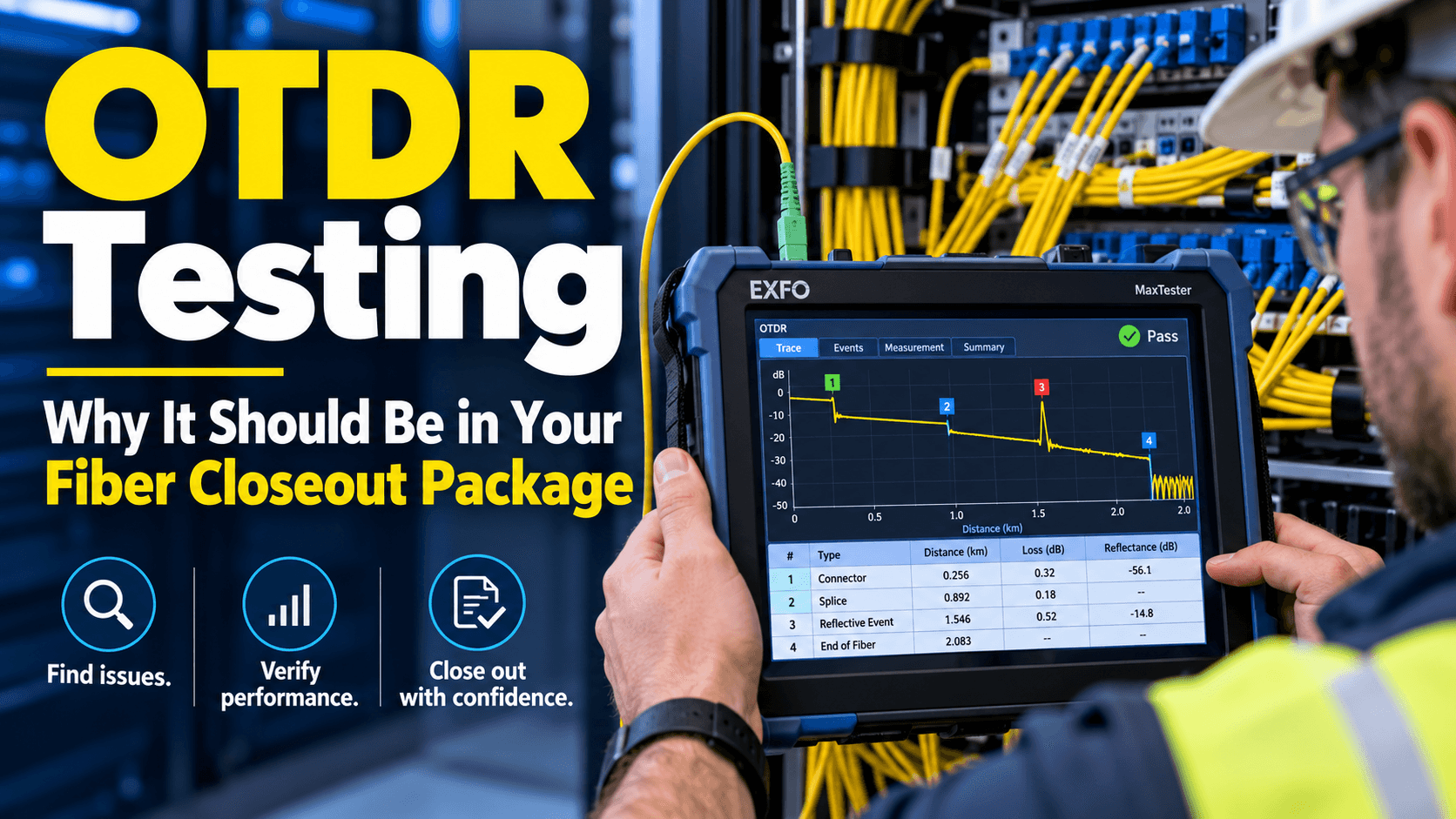
- OTDR testing (Optical Time Domain Reflectometer) sends light pulses down a fiber and records what returns, producing a trace that shows connectors, splices, and faults along the link—and roughly how far away each one is.
- Insertion-loss testing answers "how much light makes it end to end?" OTDR answers "what happens along the way, and where?"
- Many specs use insertion loss for acceptance and add OTDR for long, critical, splice-heavy, or building-to-building backbone runs.
- A fiber installation closeout package should include a link schedule, loss results with limits, OTDR traces where specified, matching labels, as-builts, and spare-strand status.
- Put the test matrix in the statement of work so acceptance is based on evidence—not "it lit in the closet."
This guide is for Facilities and IT leads buying fiber optic cabling from a commercial fiber optic contractor across Southern California campuses, office parks, and warehouses. The point is not to become an optical engineer. The point is to require the right closeout package so you can accept the work with confidence.
What Is OTDR Testing? (Buyer Language, No Heroics Required)
Think of insertion-loss testing as asking, "How much light makes it end to end?" Think of OTDR as asking, "What happens along the way, and where do notable events show up?"
An OTDR launches pulses into the fiber and analyzes returned signals to produce a trace—a graph technicians use to interpret connectors, splices, and anomalies. Trained techs read those traces. Your job as a buyer is to know when to require OTDR, what deliverables to keep, and which questions separate a real closeout from a handshake.
You do not need to interpret every spike yourself. You do need PDFs, naming that matches panels, and a clear pass/fail story tied to the links you paid for.
Why Closeout Packages Matter More Than "Lit and Good"
Commercial fiber supports cameras, access aggregation, wireless controllers, building links, and IT uplinks. When documentation is thin:
- The next TI crew re-tests everything because they cannot trust labels
- A dark spare strand becomes a mystery instead of a ready asset
- Warranty and rework conversations turn into opinions
- Multi-building campuses lose weeks chasing which panel face is "the good one"
A closeout package is how you buy transferable knowledge, not only glass in a duct. The same principle applies to copper—see what a structured cabling contractor should hand you at closeout.
OTDR vs. Insertion Loss: When Each Belongs
Both methods show up in professional fiber work. They answer different questions.
| Insertion loss (power meter) | OTDR | |
|---|---|---|
| Question it answers | How much light makes it end to end? | What happens along the fiber, and where? |
| What it measures | Total end-to-end loss against a budget | Events along the link—connectors, splices, bends, breaks—with distance |
| Typical role | Common acceptance baseline for many commercial links | Long backbones, critical campus links, splice-heavy work, troubleshooting |
| Deliverable | Loss result per link with limit and pass/fail | Trace file per strand, named to match labels |
| Easy to explain? | Yes—did the link meet the loss number? | Needs a trained tech to interpret; buyer keeps the evidence |
Many specifications use insertion loss for acceptance and OTDR where the design or owner standard requires event-level documentation—or when distance and risk justify it. Do not treat OTDR as magic that replaces polarity checks, labeling, and as-builts. Do not treat "we pinged the switch" as fiber acceptance either.
If your contractor cannot explain which tests apply to which links, pause before ceilings close.
When Commercial Buyers Should Expect OTDR in Scope
OTDR earns its keep when:
- Building-to-building or campus backbone runs are long or hard to re-pull
- Links are critical to operations (primary uplinks, security backhaul aggregation paths)
- The owner standard or engineer of record calls for OTDR traces
- You are accepting splice-heavy work and want event documentation
- Future troubleshooting cost is high (active logistics campuses, medical, multi-tenant risers)
For short, simple indoor links with clear pathways, insertion loss plus solid labeling may be the specified package. The mistake is assuming one rule fits every strand on a multi-building site. Fiber type matters too—distance and optics decisions are covered in single-mode vs. multimode fiber for commercial buildings.
Inland Empire logistics parcels near Ontario, Orange County office parks, Greater Los Angeles multi-building campuses, and San Diego portfolios all see the same pattern: the expensive links are the ones between buildings and between the MDF and distant IDFs—exactly where weak documentation hurts later.
What Belongs in a Fiber Installation Closeout Package
Require a package you can hand to the next contractor without a scavenger hunt:
- Link schedule matching drawings (from/to, fiber type, strand IDs)
- Insertion-loss results with limits and pass/fail
- OTDR traces where specified, with filenames tied to strand IDs
- Connector/polish and polarity notes as applicable
- Panel and cable labeling photos or schedules that match reality
- As-built pathway notes (conduit, innerduct, aerial, transitions)
- Spare strand inventory—what exists, what is lit, what is dark but tested
- Contact and warranty terms in plain language
If OTDR is in scope, insist traces are organized, not dumped as unrelated filenames. A ZIP of mystery PDFs is not closeout.
Coordinate fiber documentation language with your broader structured cabling standards so copper and fiber labeling do not invent two different location dialects inside the same IDF.
How OTDR Shows Up During Real Operations
Months after install, OTDR-backed documentation helps when:
- A backbone develops a problem after construction vibration or a later pull in shared conduit
- You need to argue whether damage is mid-span vs. connector-end
- A tenant improvement touches a pathway and you must re-baseline
- Spares must be validated before a camera or wireless refresh depends on them
For logistics campuses with multiple buildings, the closeout package is often the difference between a same-week network restoration and a multi-day guess across yard pathways and entrance facilities.
What OTDR Does Not Replace
Be explicit in kickoff meetings:
- OTDR does not fix a pathway that violates bend radius
- OTDR does not excuse missing labels
- OTDR does not replace optical budget planning
- OTDR does not mean every short jumper needs a theatrical test ritual if the spec says otherwise
- OTDR does not remove the need for clean connector practice
Testing is evidence. Workmanship and design still decide whether the plant is maintainable—many of the structured cabling mistakes that cause expensive service calls start with workmanship, not test gear.
Questions to Ask Your Fiber Optic Contractor
Use these in proposals and pre-construction:
- Which links get insertion-loss only, and which get OTDR—and why?
- What pass/fail limits are you using, and who set them?
- How will trace files and IL sheets map to panel labels strand-by-strand?
- Will spares be tested or only day-one lit pairs?
- What as-built pathway detail is included for building-to-building runs?
- How are retests handled after other trades disturb a pathway?
- Who explains results to Facilities/IT in a closeout meeting—not only drops a folder?
Clear answers indicate a contractor who expects to be judged on documentation. Vague answers ("we'll test everything") often mean uneven deliverables.
Sample Acceptance Checklist (Buyer-Side)
Before you sign off a fiber phase:
- ☐ Every accepted link appears on the link schedule
- ☐ IL results present with limits
- ☐ OTDR traces present where the SOW required them
- ☐ Labels at both ends match the schedule
- ☐ Spares listed with status
- ☐ As-builts show actual routes, not bid fantasies
- ☐ Admin handoff held with Facilities/IT questions answered
If any box fails, fix it before furniture and cameras make re-access miserable.
Common Fiber Closeout Failures (And How They Start)
| Failure | How it starts | Buyer fix |
|---|---|---|
| Mystery traces | No naming standard | Require strand-ID filenames |
| "Lit" only | No written test matrix | Put IL/OTDR matrix in SOW |
| Orphan spares | Tested lit pairs only | Specify spare testing |
| Pretty drawings, wrong route | As-builts copied from bid set | Field-verify pathways |
| Two labeling languages | Copper vs. fiber crews diverge | One labeling standard |
These failures are cheaper to prevent in the statement of work than to unwind during an outage—the same way vague scope turns into change orders on camera quotes.
How Fiber Closeout Ties to Cameras, Access, and Wi-Fi
Fiber is rarely "just IT." Campus backbones carry or enable:
- Camera aggregation between buildings for commercial security cameras
- Access control panels and controllers
- Wireless backhaul and switch uplinks
- Future TI density you have not scoped yet
When fiber closeout is weak, every later security or wireless project inherits doubt. When it is strong, those projects start from a known plant—whether that is cameras, access, and alarms on shared pathways or a phased legacy camera upgrade. That is why OTDR-aware closeout is an operations investment—not a niche technician preference.
Writing OTDR Into the Statement of Work
Vague language produces vague deliverables. Prefer clauses like:
- "Provide bidirectional OTDR traces for all inter-building backbone strands listed in Appendix A."
- "Provide insertion-loss results for all accepted horizontal and backbone fiber links."
- "Name all report files using Building-Panel-Strand IDs matching as-built labels."
- "Include a one-page summary of fails, retests, and final pass status."
If Appendix A does not exist yet, create it before award. Contractors cannot invent your critical-link list from a marketing walkthrough.
Realistic Expectations on Cost and Schedule
OTDR adds technician time and deliverable assembly. On small indoor jobs it may be light. On multi-building backbones it is often modest compared with the cost of an unplanned re-pull or a week of uncertainty.
Ask for OTDR as a line item with a link list, not an undefined allowance. Undefined testing is how scope disappears under schedule pressure.
Southern California projects also contend with short shutdown windows, landlord rules, and busy logistics docks. Build test time into the calendar the same way you build pull time—especially when outdoor pathways and entrance transitions are involved. If you are still choosing media, the Cat6, Cat6A, or fiber decision guide covers where fiber earns its place.
Frequently Asked Questions
What does OTDR stand for?
Optical Time Domain Reflectometer. In practice, buyers care less about the acronym and more about receiving organized traces and a clear explanation of what was tested on each accepted link.
Is OTDR required on every commercial fiber strand?
Not always. Many projects use insertion-loss testing as the baseline and add OTDR for longer, critical, or specified links. Your SOW should state the matrix so "tested" has a meaning.
Can insertion loss alone be enough for acceptance?
It can be enough when the specification says so—especially on shorter links with simple pathways. It is not a universal substitute for event-level documentation on campus backbones where fault location and splice quality matter.
What file formats should we keep from closeout?
Keep the contractor's native reports plus portable PDFs when provided, named to strand IDs, stored with as-builts in your Facilities/IT repository. The best format is the one your next vendor can open without a scavenger hunt.
Should spare strands be OTDR tested?
If spares are part of your risk plan, validate them—at least with the test methods your standard requires for that link class. Untested spares are inventory theater.
How do we know if a fiber optic contractor's closeout is complete?
Match deliverables to the SOW link list: IL results, OTDR where required, labels, as-builts, spare status, and a handoff meeting. If any accepted link lacks its paperwork, closeout is not done.
Next Step: Facility Security Modernization Review
If your campus or warehouse fiber plant needs a clearer test matrix and closeout standard—especially ahead of camera, access, or multi-building upgrades—request a Facility Security Modernization Review. Call 1-800-276-0415 or contact End-Point Wireless to discuss fiber optic installation documentation expectations with a commercial contractor. More guidance lives on the End-Point Wireless blog.
Planning a fiber installation?
Get a quote for commercial fiber optic cabling with a closeout package you can hand to the next contractor